The art of cultivating vineyards in the fertile Prosecco area was developed over many centuries: the wine was already produced as far back as Roman times using the Glera grape, which initially grew near the village of Prosecco on the Karst hills above Trieste. At that time, it was known as Puccino.
In the 18th century, cultivation of Glera expanded throughout the hills of Veneto and Friuli and later spread to the lower areas of Veneto and Friuli. This is where the Prosecco we know today was first produced at the beginning of the 20th century, thanks to the introduction of new secondary fermentation technologies.
Prosecco DOC is made with the Glera grape ( as well as a small percentage of the Pinot Noir grape for Prosecco DOC Rosé) and vinified using the Martinotti/Charmat method (also referred to as the tank method), in which secondary fermentation does not take place in individual bottles as in the Champenoise method (used to make Champagne), but in large steel tanks known as autoclaves, which keep the wine under pressure. This process was developed specifically to capture the fresh fruitiness of the Glera grape, as opposed to the yeasty, gently oxidized autolytic character of wines produced with the Champenoise method. The final result for classic Prosecco DOC is a brilliant straw yellow wine with fine, persistent perlage and aromas of white flowers, apple and pear. For Prosecco DOC Rosé, a pale pink wine with fine and persistent perlage results from an extended stop on the fermentation yeast at 60 days. Both Prosecco DOC and Prosecco DOC Rosé are fresh and elegant on the palate with moderate alcoholic strength.
In addition to Glera, regulations allow the addition of a maximum of 15% of the following varietals: Verdiso, Bianchetta Trevigiana, Perera, Glera lunga, Chardonnay, Pinot Bianco, Pinot Grigio and Pinot Noir (as used to create Prosecco DOC Rosé).
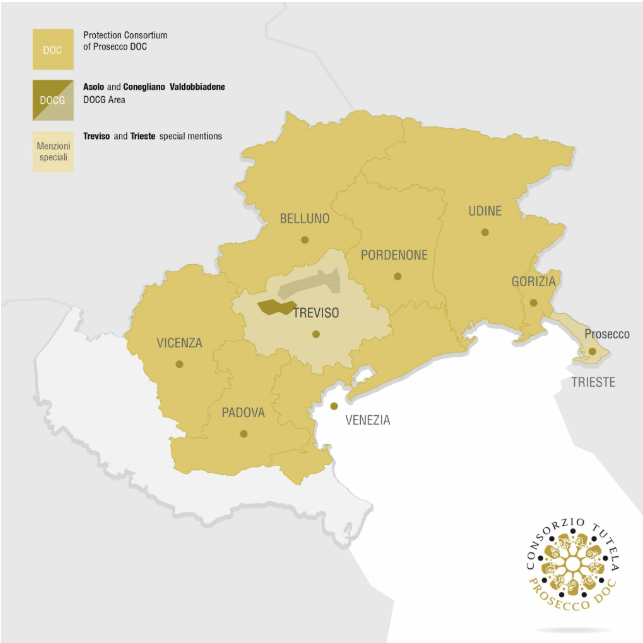
The vines from which Prosecco is produced must grow exclusively to the area of North East Italy lying between Dolomites and the Adriatic Sea. The grapes come from five provinces in the Veneto region (Belluno, Padua, Treviso, Venice, Vicenza) and four provinces in Friuli Venezia Giulia (Gorizia, Pordenone, Trieste and Udine). When the wine is also produced and bottled exclusively in the provinces of Treviso and Trieste, a special mention may be written on the label in recognition of the invaluable part these two provinces have played in the history of Prosecco.
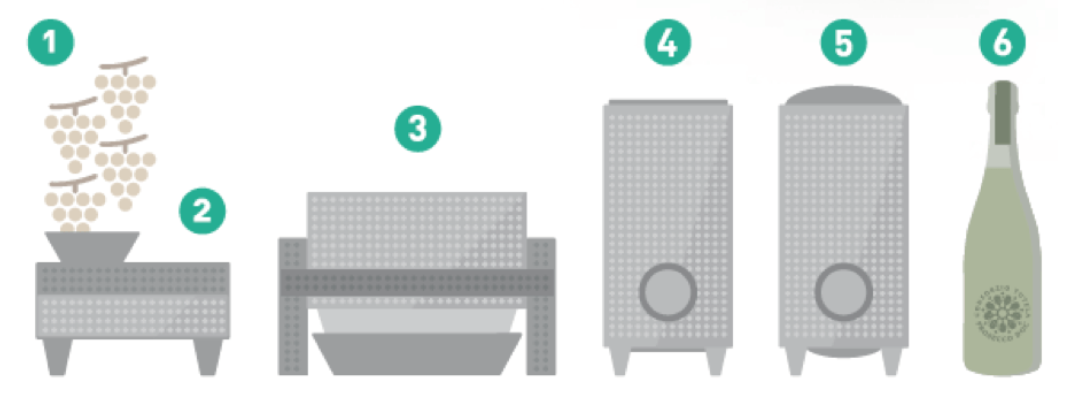
The grapes are harvested during the first weeks of September when the organoleptic qualities (sugars, acidity, and aromatic substances) have reached their peak. During this process, it is important to avoid spontaneous fermentations
1. After the grapes have been picked, they are crushed. The grapes are separated from their stems in preparation for pressing.
2. The free-run must is extracted from the grapes by soft pressing.
3. Selected yeasts are used to start the white winemaking process, transforming the sugar in the grapes into alcohol and CO2. The action of the yeasts (fermentation) lasts for around 15/20 days at a maximum temperature of 18°C to preserve the delicate aromas of the grapes. After fermentation, the ageing process begins and the wine is racked and filtered.
4. Secondary fermentation takes place using the Charmat method in large containers called autoclaves which keep the wine under pressure. This is the process by which the wine gets its famous bubbles. Toward the end of the secondary fermentation process, which lasts a minimum of 30 days, the temperature is lowered to stop fermentation, leaving enough residual sugar to guarantee balance and harmony. Secondary fermentation for Prosecco DOC Rosé lasts 60 days.
5. The wines are finally bottled and labelled.
Depending on the level of pressure, Prosecco DOC can be Spumante (sparkling), Frizzante (semi-sparkling), or Tranquillo (still) depending on the perlage. In the wines designated Spumante, the pressure is between 1 and 2.5 bars; in those labeled Frizzante, the pressure is between 1 and 2.5 bars; and in those labeled Tranquillo, the pressure is lower than 1 bar.Prosecco DOC Rosé is always Spumante.
After undergoing primary fermentation, Prosecco Tranquillo is bottled, while the Frizzante and Spumante varieties continue to the final unique stage in the Prosecco process: secondary fermentation in pressurized stainless steel tanks.
Prosecco DOC is produced in four different styles, distinguished by the quantity of residual sugar in each. Classic Prosecco DOC ranges from Brut Nature (0-3 g/l of residual sugar), Extra Brut (3-6 g/l), Brut (6-12 g/l), and Extra Dry (12-17 g/l), and Dry (17-32 g/l). Prosecco DOC Rosé ranges from Brut Nature to Extra Dry levels
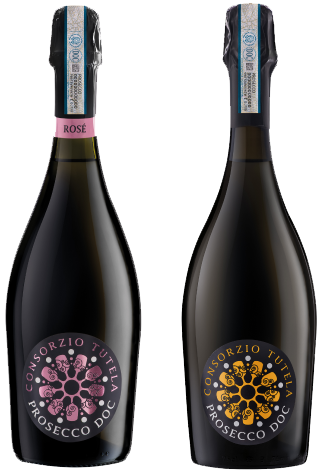
Authentic Prosecco DOC is easily distinguishable by the state seal (pictured on the right), which must be applied on each bottle. The seal is applied onto the closing of the bottle in such a way as to prevent the seal from being used again and to prevent the contents of the bottle being removed without breaking the seal. Prosecco DOC Rosé is also marked by a label of authenticity, which additionally features its Millesimato reference year.
Prosecco DOC Rosé is the newest category of Prosecco from the Dreamland
Prosecco DOC Rosé represents the evolution of the already world-famous Prosecco DOC, whose success is a result of centuries-old traditions and ancient knowledge passed down for generations, combined with the enological vocation of a territory that is in many ways unique to the world between Veneto and Friuli-Venezia Giulia, the Prosecco Dreamland.
Prosecco DOC Rosé offers a new and exciting way to meet for a toast with friends, relax after work, or elevate the everyday. Its pale pink color and fine, persistent perlage (resulting from an extended stop on the fermentation yeast at 60 days) evoke an original personality that fits in any environment with class and elegance.
Prosecco DOC Rosé is a combination of a minimum of 85% Glera grapes and 10-15% Pinot Noir. Similar to classic Prosecco DOC, the Rosé has an aroma of white flowers, apple and bright citrus: the signature descriptors of Glera. This experience is enriched by hints of raspberry bestowed by Pinot Noir.
The mouthfeel of Prosecco DOC Rosé is round and soft, but has greater structure than classic Prosecco.
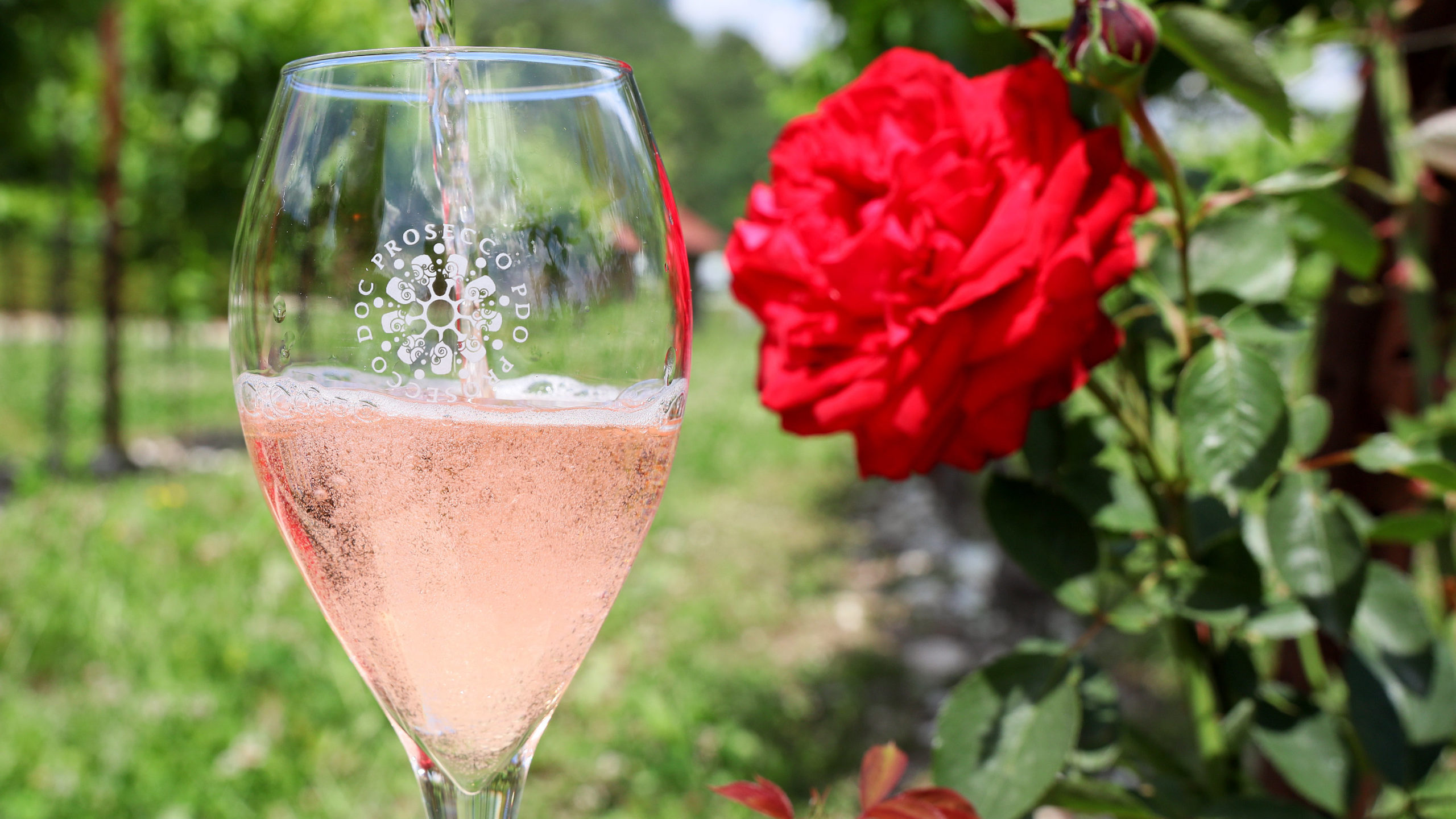
Prosecco DOC Rosé, made up of a minimum of 85-90% Glera and 10-15% Pinot Noir, is produced in the same way as Prosecco DOC. Since the two varieties have different ripening times - Pinot Noir grapes ripen between half and end of August, about two weeks before Glera’s maturation - they are vinified separately. After Pinot Noir is harvested, it is processed in the cellar, where it is vinified in red with skin contact to extract the color. The must is then separated from the skins and fermented at a controlled temperature and is ready to be blended with Glera. After that, the secondary fermentation takes place using the Martinotti/Charmat method in steel tanks called “autoclaves”, which keep the wine under pressure for a minimum period of 60 days. It is during this time that the carbon dioxide, naturally produced by the yeast, is assimilated by the wine and creates the bubbles. When the natural fermentation ends, the wine is filtered and ready to be bottled and labelled.
Marked by an official government seal on the neck of each bottle to guarantee quality and authenticity, Prosecco DOC Rosé must be produced sparkling and in the dry style: from Brut Nature to Extra Dry. The wine always boasts the Millesimato mention on the label, as Prosecco DOC Rosé must contain 85% of grapes from the vintage declared on the label.
In contrast to classic Prosecco DOC, Prosecco DOC Rosé undergoes a total of 60 days of fermentation, and can only be Spumante (with fine and persistent bubbles). The sweetness of Prosecco DOC Rosé ranges from Brut Nature to Extra Dry.
Legitimate Prosecco DOC Rosé can be identified by its state seal (pictured below), similar to the original Prosecco DOC. The label always features the Millesimato reference year, as is characteristic of all Prosecco DOC Rosé.
WHAT IS THE PROSECCO DOC CONSORTIUM (CONSORZIO DI TUTELA DELLA DOC PROSECCO)
Prosecco was granted the Controlled Designation of Origin status on July 17th, 2009, and the Prosecco DOC Consortium (Consorzio di Tutela della Denominazione di Origine Controllata Prosecco) was created on November 19th of the same year to coordinate and manage the Prosecco DOC. On August 11, 2020, the Consortium introduced the Prosecco DOC Rosé typology to the Prosecco DOC production regulation.
The organization unites winegrowers, individual and associated still and sparkling wine producers, and wineries, to ensure that the designation continues to grow and that the production regulations are always honored. The Consortium has three main objectives: to protect and safeguard the quality of Prosecco wines; to promote the wines, and to provide consumers with information on what quality, authentic Prosecco is.
WHAT IS CASA PROSECCO DOC USA?
Casa Prosecco DOC USA is the official source of news and information about Prosecco DOC and Prosecco DOC Rose’ in the United States. The Casa Prosecco DOC USA website is regularly updated with the most pertinent news regarding Prosecco, from new regulations and initiatives to harvest reports and export data to national and international events involving Prosecco. The team of Casa Prosecco DOC USA will also respond to inquiries about Prosecco from news outlets, press, and consumers via the official contact form on the website. The seat of Casa Prosecco DOC USA is the New York office of Colangelo & Partners, an integrated communications agency specializing in fine wine and spirits that has worked with several leading producers over more than a decade and has been the agency of record for the Prosecco DOC Consortium since 2014, focused on promoting and protecting the reputation and authenticity of this popular sparkling wine.
CASA PROSECCO DOC USA
Casa Prosecco DOC USA is the American bureau of Prosecco, presided over by Colangelo & Partners, an integrated communications agency.
How did Prosecco DOC Rosé come to earn its DOC distinction? Sparkling wine producers in the Prosecco DOC regions of Veneto and Friuli-Venezia Giulia have been making sparkling rosé wines for centuries. Given the growing market interest and pre existing production of sparkling rosé, the Consortium commissioned research that confirmed that 57% of the 348 wineries in the Prosecco DOC territory already produced sparkling rosé wines using a blend of Glera and Pinot Noir grapes. After experimenting on the harvest and fermentation processes of sparkling Rosé, the Consortium presented amendments to the Prosecco DOC disciplinary rules and the definition of the Prosecco DOC Rosé quality parameters, which were approved and officially declared Prosecco Rosé a Controlled Designation of Origin on August 11, 2020.
Which markets are most promising for the expansion of Prosecco Rosé? The USA are among the lead markets for Prosecco DOC Rosé, followed by Canada and Scandinavia, (both have already demonstrated particular interest for this typology), then France, fourth market for Prosecco DOC and rosé-wines lover, and, in conclusion, the South-East Asia countries. 80 to 85% of the total production of Prosecco DOC Rosé is destined to export and will conquer the markets where Prosecco DOC is already well established.
What does the new introduction of Prosecco Rosé bring to the Prosecco space and what is its potential going forward? Prosecco DOC Rosé has been the most anticipated new wine launch of 2020/21. The announcement of its new DOC status brings a new interest in the sparkling and rosé wine categories and a new way for those who already enjoy Prosecco DOC wines to experience their favorite sparkling wine. The Consortium observes that the new classification of Prosecco DOC Rosé will add to the overall increase in Prosecco DOC sales internationally. Already in 2020, 16.8 million bottles of Prosecco DOC Rosé were produced. With lots of interest surrounding the long-awaited Prosecco DOC Rosé, consumers are responding well, and the Consortium has witnessed great interest from media, trade, and consumers, as evidenced by the production of over 30 million bottles in just five months from January to May, plus 16.8 million bottles in just two months in 2020. The Consortium anticipates this number to grow even more this year, estimating production to reach around 60 million bottles by the end of the year.
The vines from which Prosecco is produced must grow exclusively to the area of North East Italy lying between Dolomites and the Adriatic Sea. The grapes come from five provinces in the Veneto region (Belluno, Padua, Treviso, Venice, Vicenza) and four provinces in Friuli Venezia Giulia (Gorizia, Pordenone, Trieste and Udine). When the wine is also produced and bottled exclusively in the provinces of Treviso and Trieste, a special mention may be written on the label in recognition of the invaluable part these two provinces have played in the history of Prosecco.
Facts & Figures on Prosecco DOC
“PROSECCO DOC IS THE MOST POPULAR ITALIAN SPARKLING WINE, IT MAKES A SIGNIFICANT CONTRIBUTION TO THE REGION’S ECONOMY AND IS THE SYMBOL OF QUALITY, SUCCESS AND THE ITALIAN LIFESTYLE."
PRODUCTION AREA/ CLIMATE
The vines from which Prosecco is produced are exclusive to north eastern Italy, lying between the Dolomites and the Adriatic Sea. Prosecco DOC is unique because of a particular interaction between climate, soil and winemaking tradition.
HUMAN FACTORS
The art of cultivating vineyards in the fruitful lands of Prosecco has been evolving over centuries, but the technique of producing sparkling wines was perfected just in the last few years thanks to the passion of the producers.
A BRIEF HISTORY
"Ed or ora immolarmi voglio il becco con quel meloaromatico Prosecco,” And now I wish to sacrifice my mouth for that apple-aromatic Prosecco) wrote Aureliano Acanti in his book, Roccolo Ditirambo, in 1754. We know that Prosecco was enjoyed even in Roman times because Pliny mentioned it in his Historia Naturalis, but it wasn’t until the late nineteenth century that Prosecco first underwent secondary fermentation to become the sparkling wine that we all know today.
PRODUCT SPECIFIC CHARACTER, TYPES
Brilliant straw yellow in color with fine, persistent perlage and aromas of white flowers, apple and pear. It is fresh and elegant on the palate with moderate alcoholic strength.– Sparkling, 76% of total production-Semi-sparkling, 23% of total production-Still, 1% of total production
PRODUCTION METHOD
Harvest
Destemming
Pressing
First fermentation
Second fermentation in autoclave
Bottling and labelling
CONSUMPTION
Prosecco pairs well with the traditional Italian dishes and its versatile character is perfect for exploring new culinary horizons of international cuisine. With its moderate alcoholic strength, Prosecco DOC can be used for aperitifs, toasts and at social gatherings.
HOW TO RECOGNIZE THE REAL PROSECCO DOC
The state mark and seal guarantees the origin and the quality.
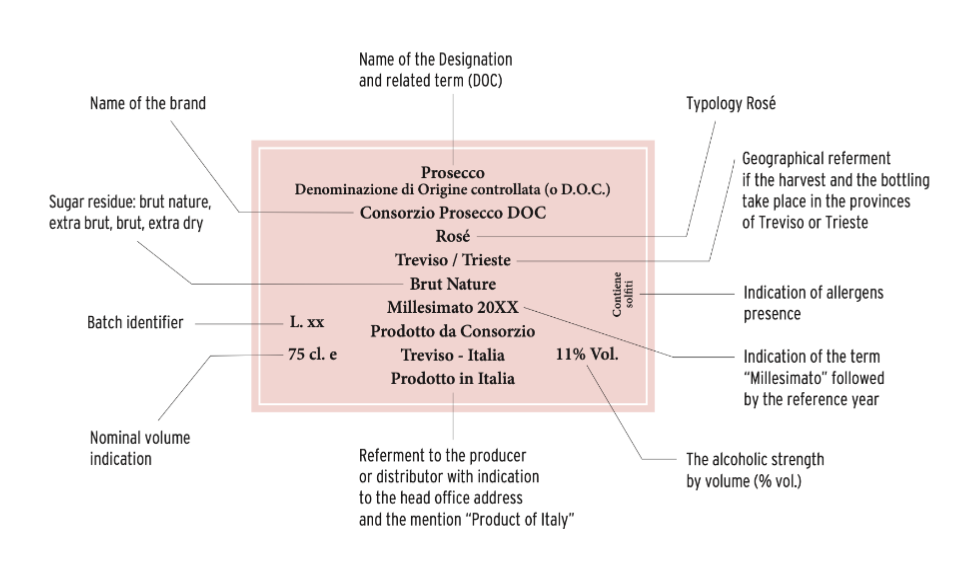
HOW TO READ THE LABEL
Prosecco DOC or Prosecco Denominazione di Origine Controllata(Registered Designation of Origin)– Prodotto in Italia (Made in Italy)– Fascetta di Stato (State mark and seal]– Spumante / Frizzante (Sparkling)